
Section 8: Sample Selected-Response Questions Subtest 3—Foundations of Bilingual Education and Instructional Practice (168)
Expand All Answers | Collapse All Answers
This section presents some sample exam questions for you to review as part of your preparation for the exam. To demonstrate how each competency may be assessed, sample questions are accompanied by the competency that they measure. While studying, you may wish to read the competency before and after you consider each sample question. Please note that the competency statements do not appear on the actual exam.
The sample questions are included to illustrate the formats and types of questions you will see on the exam; however, your performance on the sample questions should not be viewed as a predictor of your performance on the actual exam.
Selected-Response Questions with Rationales
Each sample exam question here includes the correct answer and a rationale for each answer option.
Competency 001—(Foundations of Bilingual Education): Demonstrate an understanding of the foundations of bilingual education and the educational systems that create an effective learning environment that supports the affective, linguistic, and cognitive needs of emergent bilingual students.
1. A Language Proficiency Assessment Committee (LPAC) collaborates with early childhood teachers about screening measures and approaches to effectively assess the learning and development of incoming prekindergarten children. This collaborative approach to prekindergarten screening would best promote the achievement of which of the following goals?
- establishing which curricula would most effectively expand children's readiness for kindergarten
- grouping children in classes based on their acquisition of language development milestones
- identifying children who may need additional supports regardless of their home language
- determining which experiences children have had that inform their development
- Enter to expand or collapse answer.Answer expanded
- Option C is correct because the LPAC is responsible for assessing students who may be emergent bilingual students upon their initial enrollment in Texas public schools to measure their proficiency levels in English and Spanish, to recommend placement in appropriate educational settings, and to determine which linguistic supports would best promote their academic success. Option A is incorrect because neither the LPAC nor teachers at a particular grade level determine curricular decisions in Texas public schools. Option B is incorrect because separating students into different classrooms based on their progress in achieving language development milestones and/or levels of language proficiency in Spanish or English violates both federal law and educational best practices. Option D is incorrect because the goal of the collaboration prior to the school year should be to determine how to address students' current learning and development to inform instruction. Teachers may learn about the experiences of individual students during the school year and use this information to inform instruction.
Competency 002—(Instructional Practice): Demonstrate knowledge of linguistically responsive research-based instruction and assessment methodologies and strategies that integrate language and content instruction and foster bilingualism, biliteracy, and all students' academic achievement.
2. A bilingual teacher is working on integrating Texas Essential Knowledge and Skills (TEKS) for English Language Arts and Reading (ELAR) standards with other TEKS content standards. Which of the following descriptions of a lesson planning process best demonstrates the achievement of the teacher's goal regarding students at the advanced level of English proficiency?
- As part of a science unit in which students will research inventors from the era of the Industrial Revolution, the teacher plans instruction on how to identify relevant details from a specific source.
- As part of a mathematics unit in which students will explain mathematical reasoning, the teacher plans instruction in giving oral instructions for performing multistep actions.
- As part of a technology applications unit in which students will design an original product to solve a problem, the teacher plans instruction in writing and revising drafts of nonfiction texts.
- As part of a U.S. history unit in which students will make connections between the content of the Declaration of Independence and immigration, the teacher plans instruction on how to apply strategies to self-monitor reading comprehension.
- Enter to expand or collapse answer.Answer expanded
- Option D is correct because even though emergent bilingual students at the advanced level of English reading proficiency can comprehend grade-level nonfiction and argumentative texts, the specified content area and the nature of the learning objective demand higher-order skills. History classes often require students to read both dense texts with general academic vocabulary and original texts with specialized language indicative of a particular time period, such as the Declaration of Independence. Students at the advanced level of English reading proficiency are working on monitoring and adjusting their comprehension of social studies texts by using a variety of text and discourse features to evaluate key information. Option A is incorrect because emergent bilingual students at the advanced level of English proficiency will have already acquired the skills involved with identifying relevant details from a text and have progressed to deeper engagement with the content of complex texts. Option B is incorrect because the skills of comprehending and providing multi-step instructions are acquired during the beginning and intermediate stages of English oral proficiency. Option C is incorrect because, while the skill of drafting and revising as part of the writing process is always helpful to practice, emergent bilingual students will have already received relevant direct instruction. The connection between the task of designing a product and generating nonfiction texts is also unclear.
Clustered Questions
Use the information below to answer the four questions that follow.
As part of an end-of-year (EOY) review, a Language Proficiency Assessment Committee (LPAC) considers the progress of an eighth-grade long-term emergent bilingual student. The student transferred districts within Texas last year and has reached annual linguistic goals as expected. The following excerpt is from the student's assessment portfolio.
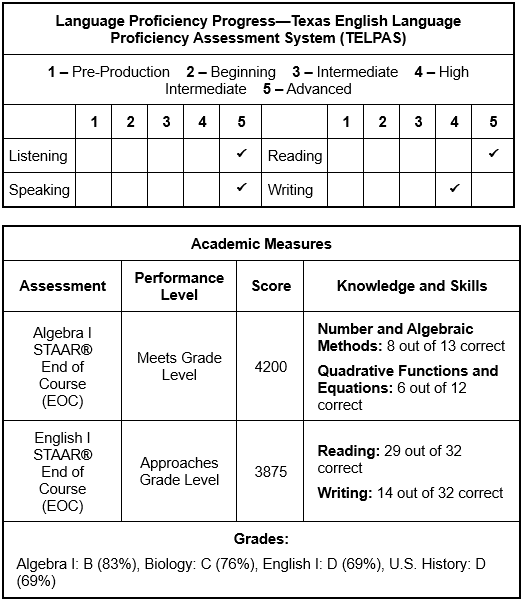
The excerpt consists of two tables. In the first table, the first row reads as follows: Language Proficiency Progress—Texas English Language Proficiency Assessment System (TELPAS). The second row provides a key and reads as follows: 1 – Pre-Production, 2 – Beginning, 3 – Intermediate, 4 – High Intermediate, 5 – Advanced. The table then provides a chart with checkboxes under a row of numbers from one to five. For listening proficiency, box five is checked and the rest are empty. For speaking proficiency, box five is checked and the rest are empty. For reading proficiency, box five is checked and the rest are empty. For writing proficiency, box four is checked and the rest are empty. In the second table, the first row reads as follows: Academic Measures. The second row consists of titles for four columns, which are assessment, performance level, score, and knowledge and skills. In the third row the assessment is Algebra One End of Course S-T-A-A-R. The performance level is meets grade level. The score is 4200. There are two categories in the knowledge and skills column. The first category is number and algebraic methods followed by the information 8 out of thirteen correct. The second category is quadrative functions and equations followed by the information 6 out of twelve correct. In the fourth row the assessment is English one End of Course S-T-A-A-R. The performance level is approaches grade level. The score is 3875. There are two categories in the knowledge and skills column. The first category is reading followed by the information twenty-nine out of thirty-two correct. The second category is writing followed by the information fourteen out of thirty-two correct. The final row in the second table is titled grades and contains the following list: Algebra One: B (83%), Biology: C (76%), English One: D (69%), U.S. History: D (69%).
Competency 001—(Foundations of Bilingual Education): Demonstrate an understanding of the foundations of bilingual education and the educational systems that create an effective learning environment that supports the affective, linguistic, and cognitive needs of emergent bilingual students.
3. Which of the following conclusions would be most appropriate to draw about the student's academic progress?
- The student likely began attending U.S. schools in the seventh grade.
- The student has likely achieved a higher level of literacy in Spanish than in English.
- The student will likely meet reclassification criteria to be successful in English-only instruction in one to two years.
- The student has likely received special education services for a specific learning disability in mathematics.
- Enter to expand or collapse answer.Answer expanded
- Option C is correct because the student has reached annual linguistic goals since transferring to the district and is close to meeting the criteria for reclassification as English proficient. Option A is incorrect because the student is identified as a long-term emergent bilingual student and has just finished the eighth grade. Option B is incorrect because there is no evidence related to the student's Spanish proficiency level in reading and writing. Option D is incorrect because there is no evidence related to special education services and the student's performance in both the Algebra I class and the Algebra I STAAR End-Of-Course assessment is sufficiently high in relation to other content areas to make a mathematics-related learning disability unlikely.
4. Which of the following actions would be most appropriate for the LPAC to take regarding this student?
- placing the student in an English-only educational environment
- developing a set of instructional interventions for teachers to use during content-area teaching
- including Spanish-language assessments of content knowledge along with English-language assessments
- recommending that the student keeps receiving emergent bilingual services and continuing to monitor the student's progress
- Enter to expand or collapse answer.Answer expanded
- Option D is correct because the student has not met criteria for being reclassified as English proficient but is making sufficient progress within a bilingual setting. Option A is incorrect because the student still requires the supports provided in a bilingual setting to achieve English proficiency in the writing domain. Option B is incorrect because the student appears to be performing sufficiently well in the content areas cited that interventions would not be warranted. Option C is incorrect because there is no information regarding the student's level of Spanish proficiency, and the assessment data show that the student is receiving content instruction in English and performing sufficiently well.
5. Based on the student's TELPAS scores, which of the following writing tasks would be most appropriate to ask the student to perform with scaffolding?
- narrating a three-paragraph story with some inclusion of detail and partial command of complex sentence structures
- composing a business letter using an appropriately formal language register and conventions
- crafting a page-long journal entry about an abstract content-area idea with occasional unnaturalness of expression
- producing a persuasive text about a controversial topic that incorporates low-frequency vocabulary
- Enter to expand or collapse answer.Answer expanded
- Option A is correct because the student has tested at the high intermediate level of English writing proficiency. Narrating a multi-paragraph story with some command of complex sentence structures and the inclusion of some detail is a skill associated with this level of English proficiency in writing. Option B is incorrect because the specialized conventions and formal register associated with writing a business letter correspond neither to the eighth-grade curriculum standards in Texas nor to the skills associated with the high intermediate level of English writing proficiency. Option C is incorrect because both the length and the abstract nature of the task are associated with the advanced level of English writing proficiency. Option D is incorrect because the skills associated with writing a persuasive text that includes low-frequency vocabulary correspond more explicitly with the advanced level of English writing proficiency.
Competency 002—(Instructional Practice): Demonstrate knowledge of linguistically responsive research-based instruction and assessment methodologies and strategies that integrate language and content instruction and foster bilingualism, biliteracy, and all students' academic achievement.
6. Which of the following instructional strategies would best promote the student's academic achievement?
- increasing the student's understanding of the reciprocal nature of reading and writing development
- leveraging the student's strengths in English oracy to promote the student's English literacy development
- incorporating writing prompts related to mathematics and science into the student's English content-area instruction
- increasing the student's use of interpersonal communication during mathematics and science content-area instruction
- Enter to expand or collapse answer.Answer expanded
- Option B is correct because the student is at the advanced level of English proficiency in all domains except for writing. Strengths in oral language transfer to literacy development, and the student has strong listening and speaking skills. An instructional approach that uses the student's strengths in oracy to promote their writing skills would allow the student to participate more fully in academic learning. Option A is incorrect because simply understanding that reading and writing development are reciprocal in nature would not necessarily have practical implications. The student has also achieved advanced-level proficiency in English reading and is at the high intermediate level of writing proficiency, indicating that the student already understands the connections between reading and writing skills. Option C is incorrect because, although the strategy draws on the student's relative strengths in mathematics and science, it does not constitute a comprehensive approach to promoting the student's writing development. Furthermore, the student is already performing sufficiently well in the content areas of mathematics and science, so these would not be the main areas of focus when considering how to promote the student's overall academic achievement. Option D is incorrect because this strategy may provide the student with additional practice in all domains of English proficiency, but it does not constitute a targeted approach to improving the student's writing skills.
Use the information below to answer the three questions that follow.
A first-grade bilingual teacher works with students who are at the beginning level of literacy and at the high intermediate level of speaking proficiency in English. The teacher engages students in a science experiment to determine which common objects react to a magnet. The teacher then encourages students to orally describe what they observe while recording what they say on an oversized notepad. The following summary is a record of the students' transcribed observations.
We had many things on a table, like a paper clip, spoon, feather, pencil, earring. We putted a magnet close to the things. The magnet attracts a paper clip and spoon and the earring. The magnet repels the paper clip and the spoon and earring from other side. Feather and the pencil didn't care about the magnet.
Competency 001—(Foundations of Bilingual Education): Demonstrate an understanding of the foundations of bilingual education and the educational systems that create an effective learning environment that supports the affective, linguistic, and cognitive needs of emergent bilingual students.
7. Which of the following features displayed in the transcription is most characteristic of students at the high intermediate level of speaking as outlined in the Texas English Language Proficiency Standards (ELPS)?
- combination of ideas using multiple cohesive devices
- expression of original messages using simple sentence structure
- narration of events using past, present, and future time frames
- communication of basic needs using high-frequency vocabulary
- Enter to expand or collapse answer.Answer expanded
- Option B is correct because the students' output consists mainly of a series of simple sentences with inclusion of some scientific terms to express their original thoughts. These language features correspond to the description in the ELPS of the high intermediate level of English-speaking proficiency for the first grade. Option A is incorrect because the transcribed student observations rely mainly on the use of "and" as a cohesive device to connect various objects rather than ideas. The advanced level of English-speaking proficiency is more closely associated with increased linguistic variety in respect to vocabulary, sentence structure, cohesive devices, etc., than is the high intermediate level. Option C is incorrect because the students' observations focus on describing past events. The students use both past and present time frames to narrate past events, but not future time frames. Option D is incorrect because the students are not communicating about needs and are using some low frequency vocabulary. The communication of basic needs using high-frequency vocabulary is more indicative of beginning and intermediate stages of English oral proficiency.
Competency 002—(Instructional Practice): Demonstrate knowledge of linguistically responsive research-based instruction and assessment methodologies and strategies that integrate language and content instruction and foster bilingualism, biliteracy, and all students' academic achievement.
8. Recording students' observations primarily promotes their academic achievement by:
- reinforcing the importance of establishing a leader during group learning projects.
- demonstrating that content learning and language acquisition are independent processes.
- encouraging students to collaborate with peers rather than pursue learning experiences independently.
- providing students with evidence of how their oral language proficiency can translate to meaningful written products.
- Enter to expand or collapse answer.Answer expanded
- Option D is correct because transcribing students' oral observations related to content learning demonstrates how the language they use in their discussions appears in writing. For these students, who are at the beginning level of English literacy, seeing their spoken output in written form is likely to increase their confidence in their ability to use language meaningfully in academic contexts. Option A is incorrect because there is no indication that there is a student in a leadership role during the activity, and the teacher is merely transcribing the students' observations without providing corrections or guidance. Option B is incorrect because the activity intertwines content learning and language development. Option C is incorrect because, while the activity is conducted as a collaboration, there is no aspect that prioritizes group learning over independent learning. Additionally, the activity involving a teacher transcribing the speech of an individual student at the beginning level of English writing proficiency would be similarly effective as a learning tool.
9. The students' use of the words attracts and repels in their description of the experiment best exemplifies which of the following statements about the relationship between English and Spanish?
- Many everyday words in Spanish have cognates in English that are used for academic purposes.
- The prefixes a- and re- share similar meanings in Spanish and English.
- Many transitive verbs in English are expressed through "dative of interest" constructions in Spanish.
- Spanish verbs undergo a greater degree of inflection to agree with their subjects than English verbs.
- Enter to expand or collapse answer.Answer expanded
- Option A is correct because attract and repel are examples of the way in which many common, frequently used words in Spanish correspond to academic vocabulary in English. Spanish evolved directly from Latin, whereas English adopted Latinate words later in its history and incorporated them frequently into academic registers rather than everyday usage. Option B is incorrect because, while the prefix a- can share the same meaning in both languages, it has many different meanings in English depending on its etymological origins. In this case, the cognates attract and atraer derive from the Latin ad. The shared Latin etymology for the prefix re- represents an area of more specific correspondence between Spanish and English morphology. Option C is incorrect because the fact that transitive English verbs may include a "dative of interest" element in Spanish is unrelated to how students are using the verbs in the scenario. Option D is incorrect because the fact that Spanish verbs are inflected more frequently than English verbs is unrelated to how the students are using the verbs in the scenario. The students are using the third-person singular form of the verbs attract and repel, which happen to be inflected in English through the addition of the morpheme -s.
Additional Selected-Response Questions
This section includes additional sample selected-response questions for you to review in preparation for the exam. The correct answer is provided for each question below.
Competency 001—(Foundations of Bilingual Education): Demonstrate an understanding of the foundations of bilingual education and the educational systems that create an effective learning environment that supports the affective, linguistic, and cognitive needs of emergent bilingual students.
10. District and school administrators and bilingual teachers meet to develop a plan to support the linguistic and academic learning needs of emergent bilingual students. While developing the plan, administrators and teachers conclude that additional teacher support is necessary to adequately meet the needs of the students. Using the outcomes of Castañeda v. Pickard as a reference point, it would be most important to emphasize which of the following positions when addressing the district to advocate for additional teacher support?
- School districts must offer emergent bilingual students a free and appropriate public education regardless of their immigration status.
- School districts must provide programs with the necessary resources so that emergent bilingual students can attain English language proficiency.
- School districts must expand eligibility for support services to include emergent bilingual students learning English as a second language.
- School districts must offer language maintenance services to support the development of home language skills of emergent bilingual students.
- Enter to expand or collapse answer.Answer expanded
- Option B is correct.
11. Representatives of the Language Proficiency Assessment Committee (LPAC) are invited to attend the Section 504 meeting of a sixth-grade emergent bilingual student who has a seizure disorder. Which of the following LPAC contributions would be most relevant to the student's Section 504 meeting?
- insights regarding how the impairment affects learning and education
- summaries about medical issues that have occurred during the school day
- health protocols that have been implemented to support student safety
- data highlighting the student's academic and linguistic strengths and needs
- Enter to expand or collapse answer.Answer expanded
- Option D is correct.
Competency 002—(Instructional Practice): Demonstrate knowledge of linguistically responsive research-based instruction and assessment methodologies and strategies that integrate language and content instruction and foster bilingualism, biliteracy, and all students' academic achievement.
12. Use the information below to answer the question that follows.
After students have viewed an educational video on the Industrial Revolution and engaged in small-group activities associated with the video, a tenth-grade bilingual teacher facilitates the following class discussion.
Teacher: For the past couple of weeks, we have learned how the Industrial Revolution improved society and made people's lives easier. But today we are going to focus on some of the negative aspects of the Industrial Revolution. What were some of the negative effects of the Industrial Revolution?
Student 1: So many gente [people] work in the factory … porque ellos podían ganar salarios más altos. Esto provocó una escasez de alimentos porque la gente abandonó sus granjas para ganar más en las fábricas [because they could earn higher wages. This led to food shortages because people abandoned their farms to earn more in the factories].
Teacher: ¡Absolutamente! Esto provocó una escasez de alimentos en los Estados Unidos y otros países. [Absolutely! This led to food shortages in the United States and other countries.] In what other ways did the Industrial Revolution negatively affect people's lives?
Student 2: People had to work in unhealthy and dangerous conditions. The working conditions were just terrible!
Student 3: ¡Y muchas de las fábricas contrataron a niños! A los niños se les pagaba muy poco y con frecuencia resultaban heridos debido a las condiciones peligrosas en las fábricas. [And many of the factories hired children! Children were paid very little and were often injured due to the dangerous conditions in the factories.]
Teacher: Great points! The Industrial Revolution, along with migration to the cities, led to poor working conditions and child labor. Can you think of some reasons why parents would allow their children to work in the factories?
Which of the following instructional strategies does the teacher use to promote students' engagement in the class discussion?
- supporting students' comprehension of content-area concepts by translating comments and questions from Spanish into English
- encouraging students to use their Spanish and English knowledge to learn content-area concepts and academic vocabulary
- alternating between English and Spanish within utterances to effectively convey important details related to content-area concepts
- providing instruction in English, the students' primary language, and introducing Spanish to maintain their home language fluency
- Enter to expand or collapse answer.Answer expanded
- Option B is correct.
13. Use the information below to answer the question that follows.
In preparation for a unit on traditional customs around the world, a third-grade bilingual teacher has students discuss their favorite family traditions in small groups. One student group uses the following anchor chart to record their contributions to the discussion.
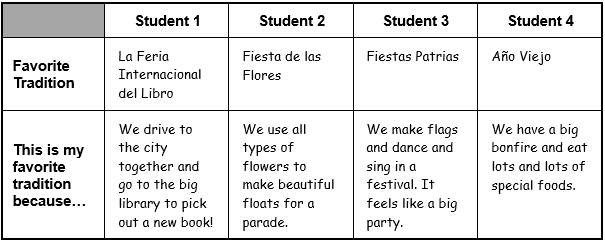
The anchor chart consists of four columns and two rows. The columns are titled student one, student two, student three, and student four. The first row reads as follows: favorite tradition. The second row reads as follows: this is my favorite tradition because. For student one, row one reads as follows: La Feria Internacional del Libro. For student one, the second row reads as follows: We drive to the city together and go to the big library to pick out a new book! For student two, row one reads as follows: Fiesta de las Flores. For student two, the second row reads as follows: We use all types of flowers to make beautiful floats for a parade. For student three, row one reads as follows: Fiestas Patrias. For student three, the second row reads as follows: We make flags and dance and sing in a festival. It feels like a big party. For student four, row one reads as follows: Año Viejo. For student four, the second row reads as follows: We have a big bonfire and eat lots and lots of special foods.
The teacher's instructional approach most directly reflects which of the following principles?
- Linking students' schemas to new information promotes concept development and makes learning meaningful.
- Learning is enhanced when students are encouraged to communicate what they know and understand to classmates.
- Offering students opportunities to demonstrate their subject knowledge promotes ownership of the learning process.
- Creating multiple activity options supports students' motivation to engage and their interest in various learning topics.
- Enter to expand or collapse answer.Answer expanded
- Option A is correct.
14. A seventh-grade bilingual teacher and an English as a Second Language (ESL) teacher collaborate to provide instruction in a dual language one-way immersion program. The teachers can most effectively serve emergent bilingual students by focusing primarily on which of the following goals during their instructional planning sessions?
- designing opportunities for students to converse for social purposes using both languages
- ensuring that students participate in similar assessments across the content areas
- identifying academic vocabulary that should be targeted for instruction in both languages
- determining the instructional practices that are most effective for each content area
- Enter to expand or collapse answer.Answer expanded
- Option C is correct.
15. A school holds a family literacy night for parents/guardians of emergent bilingual students. One of the event's topics focuses on the academic skill of organizing information. The facilitators of the event could best promote students' acquisition of this skill by suggesting that families conduct which of the following activities outside of school?
- engaging their child in home language narrative practices, such as telling stories about experiences
- including their child in home language planning activities related to daily life, such as writing the steps in a recipe and scheduling events
- prompting their child to notice the decisions they make related to language use, such as when they use their home language, English, or a combination of both
- asking their child to keep a two-column vocabulary journal that records phrases related to everyday life in the home language and in English, such as taking out the trash and washing dishes
- Enter to expand or collapse answer.Answer expanded
- Option B is correct.
Clustered Questions
Use the information below to answer the three questions that follow.
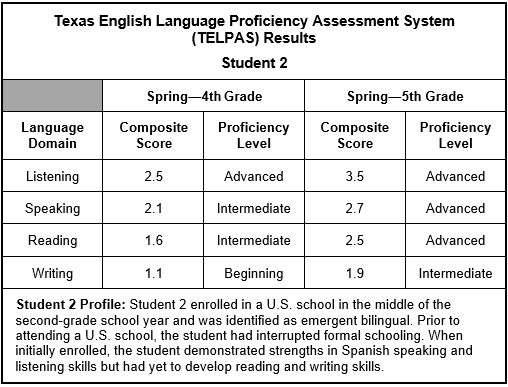
A bilingual teacher reviews the Texas English Language Proficiency Assessment System (TELPAS) data for two fifth-grade emergent bilingual students in anticipation of a Language Proficiency Assessment Committee (LPAC) meeting. The following charts show the students' TELPAS data.
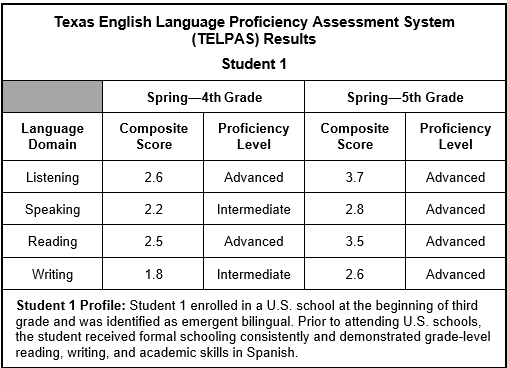
There are two charts. Each chart shows the Texas English Language Proficiency Assessment System, or TELPAS, results in all language domains for a student in the spring of fourth grade and the spring of fifth grade. Each chart also contains a brief profile of the student in the bottom row. In the spring of fourth grade, student one received a composite score of 2.6, indicating an advanced proficiency level in listening. In the spring of fifth grade, student one received a composite score of 3.7, indicating an advanced proficiency level in listening. In the spring of fourth grade, student one received a composite score of 2.2, indicating an intermediate proficiency level in speaking. In the spring of fifth grade, student one received a composite score of 2.8, indicating an advanced proficiency level in speaking. In the spring of fourth grade, student one received a composite score of 2.5, indicating an advanced proficiency level in reading. In the spring of fifth grade, student one received a composite score of 3.5, indicating an advanced proficiency level in reading. In the spring of fourth grade, student one received a composite score of 1.8, indicating an intermediate proficiency level in writing. In the spring of fifth grade, student one received a composite score of 2.6, indicating an advanced proficiency level in writing. The profile for student one reads as follows: Student 1 enrolled in a U.S. school at the beginning of third grade and was identified as emergent bilingual. Prior to attending U.S. schools, the student received formal schooling consistently and demonstrated grade-level reading, writing, and academic skills in Spanish.
In the spring of fourth grade, student two received a composite score of 2.5, indicating an advanced proficiency level in listening. In the spring of fifth grade, student two received a composite score of 3.5, indicating an advanced proficiency level in listening. In the spring of fourth grade, student two received a composite score of 2.1, indicating an intermediate proficiency level in speaking. In the spring of fifth grade, student two received a composite score of 2.7, indicating an advanced proficiency level in speaking. In the spring of fourth grade, student two received a composite score of 1.6, indicating an intermediate proficiency level in reading. In the spring of fifth grade, student two received a composite score of 2.5, indicating an advanced proficiency level in reading. In the spring of fourth grade, student two received a composite score of 1.1, indicating a beginning proficiency level in writing. In the spring of fifth grade, student two received a composite score of 1.9, indicating an intermediate proficiency level in writing. The profile for student two reads as follows: Student 2 enrolled in a U.S. school in the middle of the second-grade school year and was identified as emergent bilingual. Prior to attending a U.S. school, the student had interrupted formal schooling. When initially enrolled, the student demonstrated strengths in Spanish speaking and listening skills but had yet to develop reading and writing skills.
Competency 001—(Foundations of Bilingual Education): Demonstrate an understanding of the foundations of bilingual education and the educational systems that create an effective learning environment that supports the affective, linguistic, and cognitive needs of emergent bilingual students.
16. In addition to complying with federal and state requirements to assess the students' English language proficiency, the TELPAS was administered annually for which of the following purposes?
- describing how the students' home language influences their English language acquisition
- quantifying how much progress the students have made toward grade-level learning standards
- comparing the students' English language progress to that of same-age bilingual emergent students
- determining which instructional program and supports would meet the language needs of the students
- Enter to expand or collapse answer.Answer expanded
- Option D is correct.
Competency 002—(Instructional Practice): Demonstrate knowledge of linguistically responsive research-based instruction and assessment methodologies and strategies that integrate language and content instruction and foster bilingualism, biliteracy, and all students' academic achievement.
17. Based on the TELPAS data, Student 2 would most likely engage in which of the following oral language activities in English given minimal supports or scaffolds?
- narrating a personal experience with details and complete sentences
- participating in academic conversations using abstract vocabulary
- describing a scientific process accurately using technical language
- debating a topic using claims and counterclaims from multiple sources
- Enter to expand or collapse answer.Answer expanded
- Option A is correct.
18. Which of the following factors has most likely influenced the progress of Student 1?
- underlying strengths in oral receptive and expressive language
- duration of time enrolled in a program with English language support
- development of foundational literacy skills in the home language
- exposure to robust language models in the home environment
- Enter to expand or collapse answer.Answer expanded
- Option C is correct.